

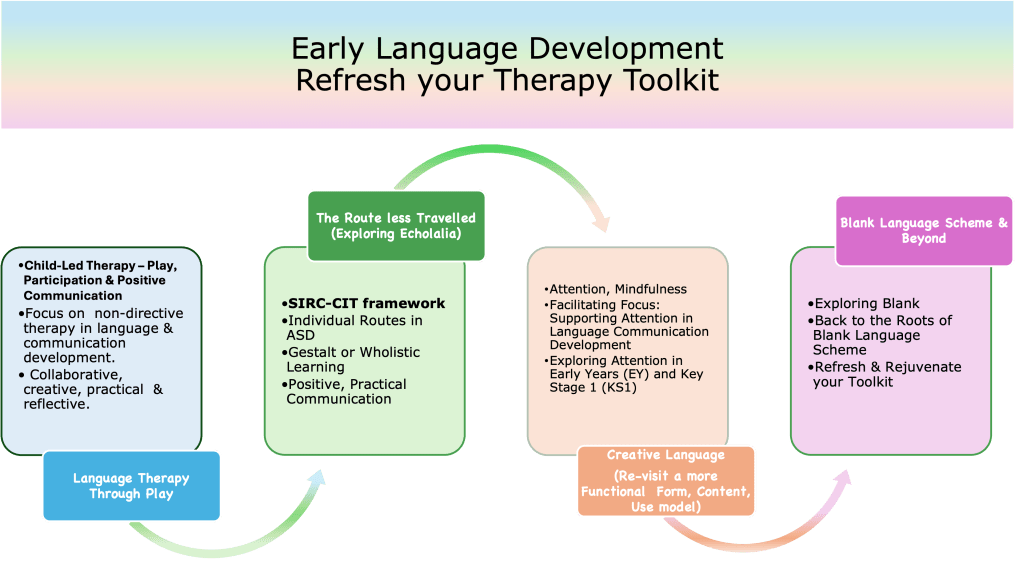
Child-Led Therapy: Play, Participation & Positive Communication
A Study Day focusing on Child-Led or Non-Directive Therapy
The day focuses on Non-Directive Therapy in early language and communication development, the theory underpinning child-led therapy and the “How To’s” in this approach.
Key Themes:
- What does Child-Led really mean? Moving beyond just playing on the floor. It’s about communicative connections, creating ‘space to think’, and working through play choices.
- The evidence base: Considering why non-directive/child led approaches are effective (e.g., in engagement, generalization and motivation to interact, share play and communicate).
- The history of non-directive therapy in Speech and Language Therapy.
- It’s a Continuum: Acknowledging that “child-led” can be seen as a continuum, and it’s about finding the right balance of strategies for each child, family, and setting.
- Looking at the concept of Special Time in Adult-Child interactions – visiting Hanen, Palin PCI, Verve and other approaches which families are exploring such as gestalt language acquisition to draw on these approaches in individual language plans for children with developmental delay, autistic spectum disorder and other conditions.
SIRC-CIT: Exploring Individual Language Routes in ASD: Profiles and Practical Strategies (Wholistic Language Facilitation)
This course is about valuing echolalia (increasingly called Gestalt/wholistic) within an evidence based framework.
Gestalt is a complex topic of debate in the profession and with families and settings at this time. This Study Day focuses on the evidence, including Peters ( 1977 ) and Prizant (1982) and equips you with knowledge about Gestalt and the history of this approach, and highlights what is evidence based within the approach.
This includes Child Led therapy, Scripts (Nelson), Wholistic/Gestalt echolalia and analytical processing (Prizant).
During the course the two routes to Language in the GLP model are considered. What is Gestalt (aka Wholistic, Formulaic or Scripted) and Analytical (aka Creative) Language Routes.
The jargon will be de-mystified ….
Throughout there is an emphasis on individual patterns of development.
There is a focus on using a selection of Profiles for assessment and the planning & practicalities of therapy.
“Bubble bubble … pop” is a gestalt (wholistic utterance) I recently observed used by a 16 month old child which she had learned in one scenario and then re-applied in another. This child has a profile with strong aspects of both gestalt and emerging analytical language development. As clinicians working with ASD we know children’s learning style for language can be different.
In preparation for the Study Day the evidence, research has been explored and Prizant and Duchan’s early work re-visited.
In a recent podcast Barry Prizant said “My simple advice:Listen, observe,and ask ‘Why?'” and this is the approach of this course.
Background
There is currently much discussion about ‘Gestalts’ in comparison with ‘Analytical’ routes to language for children with ASD. Parents and teachers are talking about this approach and it is important to know about it. There are questions and requests for guidance from speech and language therapists. There are some very specific frameworks and approaches available. There is also a lot of confusion and uncertainty.
Language development in autistic spectrum disorder is the course leader’s specialist interest. Ruth was an RCSLT Specialist Clinical Adviser in ASD for many years, beginning to serve in this role while working at an assessment nursery and mainstream designated specialist provision for children with autistic spectrum disorder.
Ruth shares her enthusiasm, knowledge and expertise in early language and communication development in autism. Information and resources linked to a Creative Communication framework are provided.
Key points have been compiled into a simple framework which a busy therapist can practically put into practice.
The framework is now called
SIRC – CIT : Supporting Individual Routes in Communication – Connecting through Interactive Therapy
An approach to communication assessment, planning & facilitation which is friendly to the learning style of autistic children.
The framework provides a way of compiling an assessment profile and then mapping the individual therapy supports needed to facilitate a child’s language and communication skills.
The objective is always confidence and communicative competence.
Course Themes
Exploring Analytical Language Development
What is Gestalt ? (aka Wholistic or Scripted language)
The responsive Communication Partner
The Six Stages of Gestalt development (NLA)
Starting Point – A Communicative Connection
Revisiting the Cognitive foundations of early communication – joint attention and scripts
Profiling Language (Using Profiles for evaluation)
Individual Supports and Strategies
Therapy approaches which work – Follow Ins, Child Led, Non-Directive
Is it a Plan or a Map for Development?
Devising and setting up an individual therapy plan, which values Gestalt/Wholistic language and meets a child’s needs. How to track and adjust this plan over time.
Showing how a plan can be individual, neuro-affirmative and ‘gestalt friendly’.
Utilising the approach to learning based on Vygotsky’s zone of teaching/development.
Summary
During the Study Day we will go beyond gestalt and look at profiling individual patterns of language acquisition. It’s about knowing a child’s individual strengths and patterns in early communication development.
Then planning intervention in everyday communication environments. There is focus on extending a child’s interests in play, facilitating confidence and competence in communication.
After attending you will be able to talk about gestalt routes to language with parents and other professionals with confidence.
This Study Day focuses on the process of early language development and the individual routes taken by children. The use of Profiles and other resources will be shared as a way of recording a child’s individual route and tracking change over time
SIRC – CIT : Supporting Individual Routes in Communication – Connecting through Interactive Therapy
This is simply compiling a range of intervention strategies which are evidence based. Four phases of communication development are explored with a range of ideas relevant for each phase. We work through Connecting in Communication to Creative Story Talk through child led interaction and play
The message is to know the evidence, be confident in your clinical decision making and develop your own toolkit of techniques for supporting communication development.
Blank & Beyond: Exploring this Interactive Language Therapy Approach
Join Ruth for an online Workshop where we explore into Marian Blank’s Language Framework.
Many of us use the TALC (Test of Abstract Language Comprehension) from ELKLAN. This Workshop takes a different (though complimentary focus). During the Workshop we return to the literature /evidence and explore the Framework in depth.
Marian Blank’s approach to therapy involves choosing activities which are within a child’s language processing comfort zone and extending language and perceptual thinking through interactive questions and comments during the practical activity. It is a different approach to therapy and although many of us use the 4 Levels the activity based therapy framework seems to have been overlooked.
Who are they for?
The Study Day is of interest to SLTs, Assistant Practitioners, Early Years Specialists.
For any queries on any of the above please don’t hesitate to contact us
 Speech & Language Therapy Training & Development