


RESILIENCE
This year I am working hard at putting my positive psychology learning into action and trying to value the change in the seasons. As a keen herb gardener I find the weeks when the garden dies back difficult. I’d like to get back to enjoy mist filled mornings, changing colours of the trees and roast chestnuts and baked apples. I’m getting there! Not 100 % success but some progress. Some of you know that ‘the other me’ writes about mindfulness, slow travel and blog about nature and the changing seasons here at my home.
That brings me nicely on to Resilience. At this time of year on a clear day we see the cranes migrating across to the south. And they actually do that thing which we learn about on Leadership Training. I believe it used to be in the original edition of Hanen It Takes Two To Talk. What happens is that when the leader gets tired the group pauses and circles and moves position so someone else takes the load of leadership for a while.
In some SLT roles that isn’t possible. There is no one to take on the role. You might be a sole trader or the only one in your team with a specific skill set. So how do you keep yourself well. What do you do to be a ‘self-renewing therapist’?! We consider this on the clinical supervision study day. It’s an individual thing and what works for one person might be totally wrong for another. It doesn’t matter. This is about self reflection and knowing what your kit of self supportive strategies includes.
There is some research into preventing Burnout in healthcare professions. I dip into Sanya Wallbank’s strategies on the clinical supervision training, but decided more time was needed on the Restorative Resilient Function of Supervision. So far, there haven’t been enough people to make a course viable but there is a date in the spring and I’ll do some advertising and generate some interest. The idea is to explore coping with pressure in our roles and look at the research and reflect on what works for each of us. This also involves what to do if you are supporting or supervising someone who is approaching Burnout.
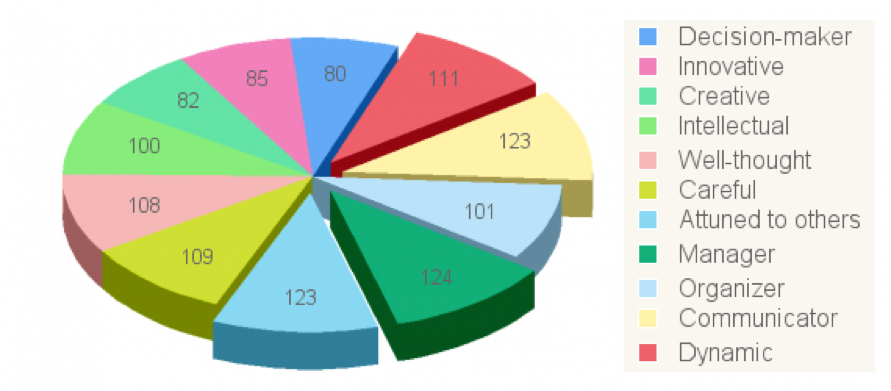
I came across this strange tool recently which seems to work, but I have no idea how. It is one of those personality evaluations and this one involves choosing a range of colours you like then ones you don’t like before getting a print out.
Try it here: TestColor
Mine seemed to be uncannily accurate but it clearly can’t have any science behind it. What it can do is give you a quick and easy evaluation which you can then have a conversation around. If something identifies strengths and leads to a positive conversation then it has some value. I’ve just done this again and it is gives me a different profile! I still like it as a very quick way of producing something visual which can form the basis of a conversation about our strengths. It is so quick and easy to complete that I hope there is something in it!
See my Profile below!
So, lots happening at Arc Supervision. The Clinical Supervision Study Day continues (next one scheduled for February 6th) and an Advanced Supervision Day is coming next year. The Restorative Resilience Focused Day is ready to run. The CPD Short Workshops of Mindful Leadership, Appreciative Leadership and Time/Energy Management are available on request for individuals or groups. The dream is to hold an Assistants Day in the summer, but it can be much harder for Assistant’s to get funding for training so it is hard to gauge whether it will be viable.
I’m doing much more writing (unrelated to speech and language therapy) so I’m taking on fewer new supervisees. I don’t plan on stopping supervision – just working differently. I plan to scale down over time and focus on writing. I am also re-visiting mindfulness and doing a Mindfulness Teacher Training course in the New Year. Mindfulness isn’t for everyone so I don’t routinely bring it into supervision sessions, but if anyone wants a mindful approach then just say – and this can easily be added as can ACT (acceptance and commitment therapy).
If you’re interested in any training, then let me know.
Every year is different and we’ve had some happy and sad family events in the last 12 months. I don’t get ‘it right’ all the time, but know it is about how I respond and react and get back to that place of calmness and regulation.
ACT Acceptance & Commitment Therapy
I did a course on ACT last year. I have found it transformative in Supervision. The Diffusion (in the diagram) “Observe your thoughts without being ruled by them”
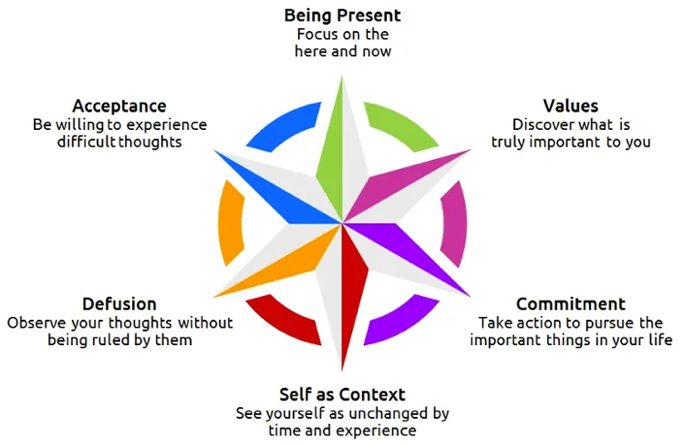
ACT was developed in the 1980s by psychologist Steven Hayes (University of Nevada) partly from Hayes’s own experience of panic attacks. He focused on no longer running and accepting himself and his experiences. In Speech and Language Therapy there are clinical applications in some areas and certainly in Adult Fluency. I wish I had known more about ACT when I was supporting families of children with complex needs. It would have given me a valuable source of strategies in family work.
After listening to someone’s self talk and knowing a little about what drives their thinking, the focus is on bringing in more confident and optimistic thinking and interacting. There is focus on how we relate and react to experiences. Exploring personal values and goals is also important (what’s important to us at home and work). The conversations cover recognising emotions and adapting thoughts and behaviours to “align with your values and goals”.
If anyone is interested in ACT then this video by Professor Nuno Ferreira gives some insight.

 Speech & Language Therapy Training & Development